Designated Marksman Rifles Compared: C20 DMR, RSASS, M110A1 & SCAR-H Mk20
Designated Marksman Rifles Compared: Semi-Auto Precision Rifle Platforms Explained
Designated marksman rifles, often called DMRs, are built to fill the gap between standard infantry rifles and dedicated sniper rifles. A DMR is typically a semi-automatic precision rifle configured for greater accuracy, better optics, improved stability, and longer effective reach than a standard service rifle.
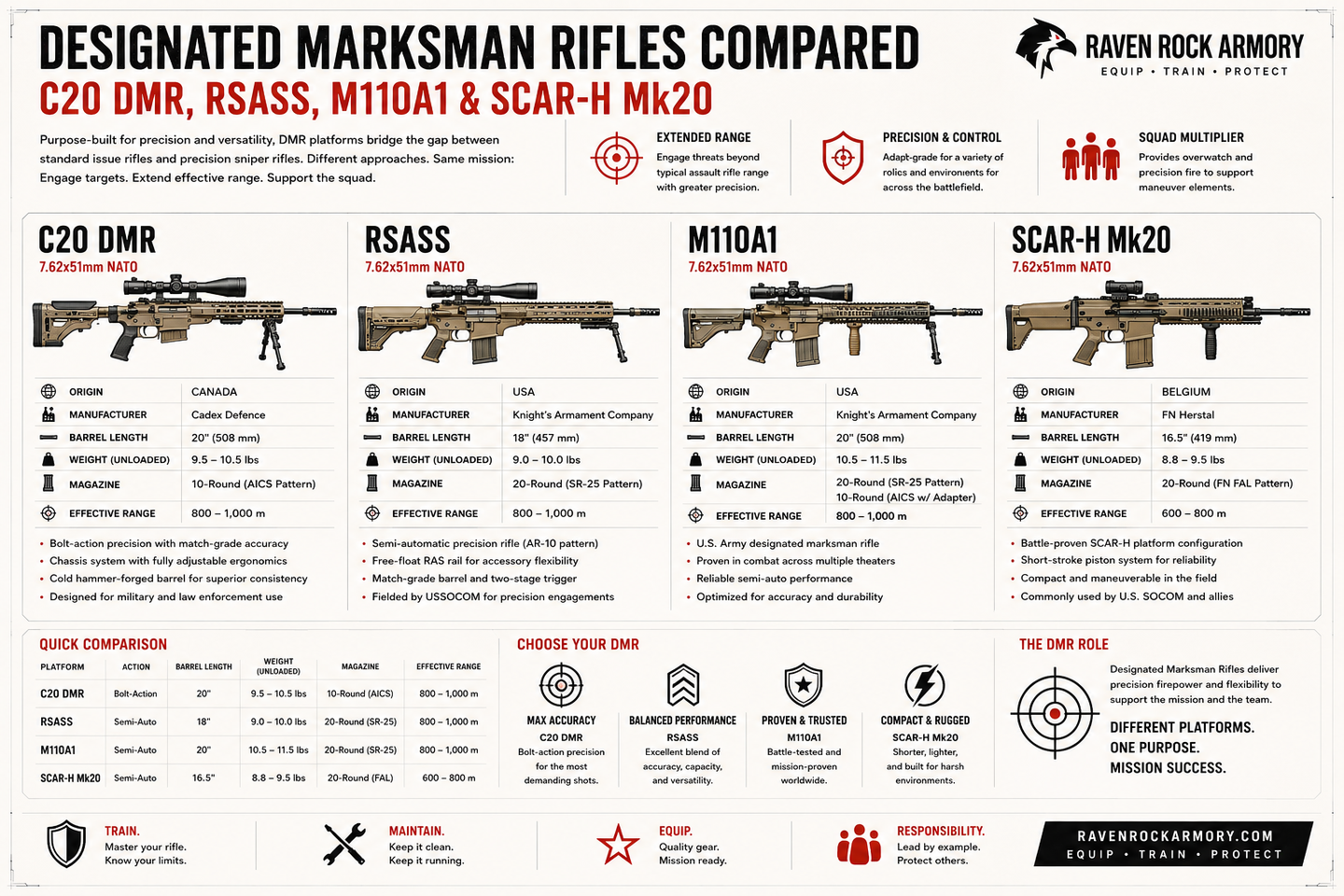
The image highlights several well-known DMR and semi-auto precision rifle platforms, including the Colt Canada C20 DMR, Remington R11 RSASS, Chukavin SVCh, M110A1 SDMR, and FN SCAR-H Mk20 SSR. These rifles are generally associated with 7.62 NATO, 7.62x54R, or similar full-power rifle cartridges designed for extended-range accuracy and increased downrange energy.
At Raven Rock Armory, customers can browse rifles, tactical rifles, rifle ammunition, rifle scopes, gun rests, bipods, and tripods, and related tactical gear for range use, hunting, precision rifle setups, and responsible firearm ownership.
What Is a Designated Marksman Rifle?
A designated marksman rifle is designed to support accurate fire at longer distances than a standard carbine or general-purpose rifle. Unlike a bolt-action sniper rifle, a DMR is usually semi-automatic, allowing faster follow-up shots while still offering improved precision and better optics than a standard rifle setup.
Common DMR features include a heavier barrel, magnified optic, improved trigger, adjustable stock, bipod, suppressor-ready configuration where legal, match-grade ammunition compatibility, and a caliber capable of better performance at distance.
Colt Canada C20 DMR
The Colt Canada C20 DMR is a modern designated marksman rifle concept based around a precision-oriented semi-automatic platform. It is commonly associated with 7.62x51mm NATO and a magnified optic setup, giving it greater reach and energy than smaller intermediate-caliber carbines.
For civilian buyers, the C20 DMR concept is useful because it shows what many shooters want in a precision semi-auto rifle: a stable platform, quality optic, bipod support, strong ammunition performance, and the ability to make accurate follow-up shots.
Remington R11 RSASS
The Remington R11 RSASS, or Semi-Automatic Sniper System, represents the AR-10 / SR-25 style precision rifle category. These rifles are often chambered in 7.62 NATO / .308 Winchester and designed around accuracy, optics compatibility, suppressor-ready use where legal, and semi-automatic follow-up capability.
For customers comparing similar civilian rifles, the important considerations include barrel length, trigger quality, optic mount, ammunition selection, magazine compatibility, rifle weight, and whether the rifle will be used for target shooting, hunting, or long-range range work.
Chukavin SVCh
The Chukavin SVCh is a Russian designated marksman rifle concept intended as a modern replacement or companion to older precision support rifle designs. The image lists it with 7.62x54R, a full-power rimmed rifle cartridge with a long history in military and precision rifle applications.
For most U.S. civilian shooters, the SVCh is more useful as a design comparison than a common retail option. It shows the continued global interest in semi-automatic precision rifles built for extended-range support roles.
M110A1 SDMR
The M110A1 Squad Designated Marksman Rifle is based on an HK417 / G28-style platform and is chambered in 7.62 NATO. It is designed to give a squad-level marksman increased precision and range while keeping semi-automatic capability.
The M110A1 concept is especially relevant to civilian shooters comparing premium .308 / 7.62 NATO semi-auto rifles. It highlights the importance of optics, barrel quality, trigger control, bipod support, and consistent ammunition.
FN SCAR-H Mk20 SSR
The FN SCAR-H Mk20 SSR is a sniper support rifle variant of the SCAR-H platform. It is designed around 7.62 NATO performance, a longer barrel, precision stock system, magnified optic compatibility, and a role focused on accuracy and support fire at distance.
SCAR-H style rifles appeal to shooters who want a premium semi-auto .308 / 7.62 NATO rifle with modern controls and a distinctive operating system. The tradeoff is usually higher cost, rifle weight, and more limited parts support compared to common AR-10 style platforms.
7.62 NATO and .308 Winchester in DMR Platforms
Many designated marksman rifles use 7.62x51mm NATO or .308 Winchester because these cartridges offer more energy and better long-range capability than smaller intermediate rifle cartridges like 5.56 NATO. They are also widely supported in precision rifle, hunting, and semi-auto rifle platforms.
The tradeoff is recoil, ammunition weight, rifle weight, and cost. A .308 / 7.62 NATO rifle can be excellent for distance and power, but it is usually heavier and more expensive to train with than a 5.56 rifle.
Customers can browse rifle ammo at Raven Rock Armory to compare available calibers for range training, hunting, tactical rifle setups, and precision shooting applications.
Optics for Designated Marksman Rifles
Optics are one of the most important parts of a DMR setup. A designated marksman rifle usually benefits from a magnified optic, such as a rifle scope, LPVO, or precision-oriented scope with reliable adjustments and a useful reticle.
Magnification helps identify targets, refine aiming, and improve precision at distance. However, too much magnification can make the rifle slower at closer ranges. The best optic depends on the rifle, caliber, shooting distance, and intended use.
Raven Rock Armory offers related optics categories including rifle scopes, LPVO scopes, prism scopes, and magnifiers.
Bipods, Suppressors, and Rifle Support Gear
DMR platforms often use bipods, stable shooting rests, adjustable stocks, and sling setups to help the shooter maintain consistency. A bipod can help stabilize the rifle from prone or supported positions, while an adjustable stock can improve fit and comfort.
Some DMR platforms are also shown with suppressor-ready configurations. Suppressors, where legal, can reduce muzzle blast and change the shooting experience, but they are regulated items and must follow all ATF, NFA, and SOT requirements.
Customers can browse gun rests, bipods, and tripods, muzzle devices, and Class III / NFA categories for related items where available and legally permitted.
DMR vs. Sniper Rifle vs. Standard Rifle
A standard rifle is usually built for general-purpose use. A designated marksman rifle adds better optics, improved precision, and more effective reach. A dedicated sniper rifle is usually more specialized, often bolt-action, and built around maximum precision rather than rapid follow-up fire.
For many civilian shooters, a DMR-style rifle can be a practical middle ground. It offers better precision than a basic carbine while still keeping semi-automatic capability. The key is choosing the right caliber, optic, support gear, and ammunition for the intended use.
Related Categories at Raven Rock Armory
- Firearms
- Rifles
- Tactical Rifles
- Ammunition
- Rifle Ammo
- Optics
- Rifle Scopes
- Gun Rests, Bipods & Tripods
- Muzzle Devices
- Class III / NFA
- Special Orders
Final Thoughts
Designated marksman rifles are built around a specific role: extending the effective reach of a rifleman while keeping semi-automatic capability. Platforms like the Colt Canada C20 DMR, Remington R11 RSASS, Chukavin SVCh, M110A1 SDMR, and FN SCAR-H Mk20 SSR show different approaches to semi-auto precision support rifles.
For civilian buyers, the practical lesson is to focus on the full system: rifle, caliber, optic, ammunition, bipod, muzzle device, trigger, and training. Whether you are comparing .308 rifles, tactical rifles, rifle scopes, bipods, muzzle devices, or special order options, Raven Rock Armory offers organized categories and local support for responsible firearm owners.
Important: Firearms, ammunition, magazines, suppressors, and regulated accessories must comply with all applicable federal, state, and local laws. NFA / Class III items must follow all ATF and SOT requirements. Firearms must transfer through a valid FFL where required. Product availability, legality, and transfer requirements may vary.
Explore Popular Articles
Top 10 AR-15 Manufacturers - Raven Rock Armory
AR15 Carbine Buffer Assembly