
Raven Rock Armory
Red Dot Magnifiers & Flip-to-Side Magnifiers
Shop red dot magnifiers and flip-to-side magnifiers at Raven Rock Armory. Compare 3x, 5x, 6x, and other magnification options with compatible mounts, adjustable diopters, quick deployment systems, and optic-height configurations for pairing with compatible red dot and holographic sights.
Learn more about red dot magnifiers
An optic magnifier is positioned behind a compatible red dot or holographic sight to provide additional optical magnification. Many systems use a flip-to-side or quick-release mount so the magnifier can be moved out of the sight picture when magnification is not needed.
3x Red Dot Magnifiers
A 3x magnifier is a common pairing for unmagnified red dot and holographic sights. It provides additional target detail while generally maintaining a compact size and moderate weight.
5x & Higher-Power Magnifiers
Higher-power magnifiers can provide additional target detail compared with lower-power models. Increased magnification may also affect field of view, eye relief, size, weight, and how quickly the user acquires a complete sight picture.
Flip-to-Side Magnifier Mounts
Flip-to-side mounts allow the magnifier to move laterally away from the primary optic's viewing path. This lets the user alternate between an unmagnified sight picture and magnified viewing without removing the magnifier from the firearm.
Choosing a Magnifier
- Magnification: Choose a power level appropriate for expected shooting distances and desired target detail.
- Optic Height: Confirm that the magnifier and primary sight can be aligned at compatible heights.
- Eye Relief: Compare manufacturer eye-relief specifications and available mounting space.
- Mount Type: Check whether the magnifier includes a fixed, flip-to-side, quick-release, or separately purchased mounting system.
Red Dot & Holographic Sight Compatibility
Magnifiers are commonly paired with compatible red dot and holographic sights. Physical alignment, sight height, mounting space, and manufacturer specifications should be checked before combining components from different product families.
Absolute & Lower-Third Heights
Primary optics can be mounted at different heights above the rail. Magnifier mounts may include spacers or adjustable configurations to align the magnifier with commonly used optic heights. Verify actual specifications for the specific optic and mount combination.
Diopter Adjustment
Many magnifiers include a diopter adjustment that allows the viewed image or aiming reference to be focused for the user's eyesight. Proper adjustment can improve clarity and viewing comfort.
Windage & Elevation Alignment
Some magnifiers include adjustment controls used to center the primary optic's reticle within the magnified field of view. These alignment controls are different from the primary optic's zero adjustments.
Field of View
Field of view generally becomes narrower as magnification increases. Compare magnification, optical clarity, field of view, eye relief, and intended use rather than selecting solely by maximum magnification.
Mounting Space & Rear-Sight Clearance
A magnifier normally mounts behind the primary optic and therefore requires sufficient rail space. Folding iron sights, charging handles, optic placement, and other equipment can affect the available mounting position.
Durability & Environmental Protection
Consider housing material, mount construction, recoil rating, water resistance, fog resistance, lens coatings, operating temperature, and manufacturer warranty when comparing magnifiers for frequent range or field use.
Mounting & Inspection
Follow magnifier, mount, primary optic, and firearm manufacturer instructions for installation and fastener torque. Periodically inspect the magnifier and mount for movement, loosened hardware, wear, or damage.
Filter By
Products List
-
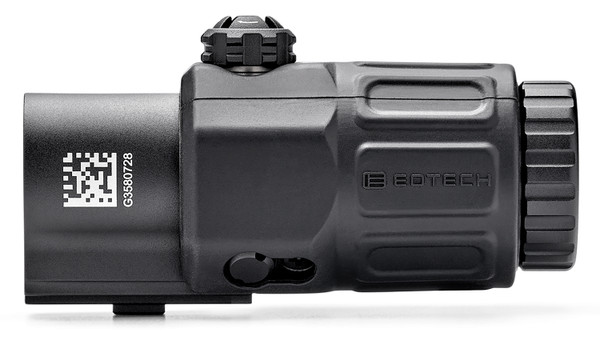
Eotech G33.NM 3x Magnifier with Quick Transition and Adjustable Focus
EotechOUR PRICE: $532.99Eotech G33.NM G33 Magnifier Black 3x 1" Weaver/MIL-STD-1913 Rail Mount The Eotech G33.NM 3x Magnifier is a lightweight, compact optic favored by USSOCOM for its durability and versatility. Designed... -
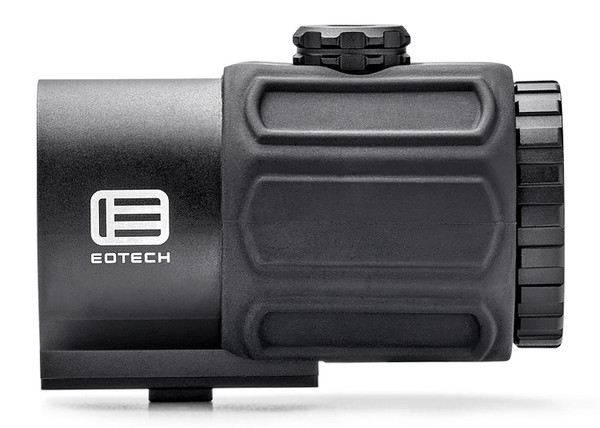
Eotech G43.NM 3x Magnifier with No Mount Black
EotechOUR PRICE: $557.99Eotech G43.NM G43 Magnifier Black 3x 1" Weaver/MIL-STD-1913 Rail Mount The Eotech G43.NM 3x Magnifier is a compact and lightweight optical enhancement designed for quick target acquisition and... -

Eotech G45.NM 5X Magnifier with Quick Transition and Adjustable Optic
EotechOUR PRICE: $604.99Eotech G45.NM G45 Magnifier Black 5x 1" Weaver/MIL-STD-1913 Rail Mount The Eotech G45.NM 5X magnifier offers precise 5X magnification for enhanced long-distance target engagement, making it ideal for... -

Eotech G33.NMTAN 3X Magnifier for EOTECH HWS with 7.3° FOV and 2.2" Eye Relief
EotechOUR PRICE: $532.99Eotech G33.NMTAN G33 Magnifier 3x No Mount Tan/FDE The EOTECH G33.NMTAN 3X Magnifier is a compact and lightweight optic designed for quick target acquisition and enhanced precision. Trusted by... -

Eotech G43 3x Magnifier No Mount Complete Tan/FDE
EotechOUR PRICE: $557.99Eotech G43.NMTAN G43 Magnifier 3x No Mount Tan/FDE The Eotech G43 is a compact and lightweight 3x magnifier designed for quick and flexible target engagement. It features a quick-transition mount... -

Eotech G45.NMTAN 5X Magnifier No Mount Tan FDE
EotechOUR PRICE: $604.99Eotech G45.NMTAN G45 Magnifier 5x No Mount Tan/FDE The Eotech G45.NMTAN 5X Magnifier provides shooters with enhanced precision and a clear 5x magnification, ideal for long-range engagements. Its...
