Precision Rifle vs Anti-Materiel Rifle: .338 Lapua Magnum vs .50 BMG
Precision Rifle vs. Anti-Materiel Rifle: .338 Lapua Magnum vs. .50 BMG Compared
Precision rifles and anti-materiel rifles are often discussed together because both are associated with long-range shooting, large cartridges, powerful optics, and specialized rifle platforms. However, they are not designed for the same role. A precision rifle is typically built around accuracy, consistency, and shooter control, while an anti-materiel rifle is built around power, heavy projectile energy, and specialized long-range capability.
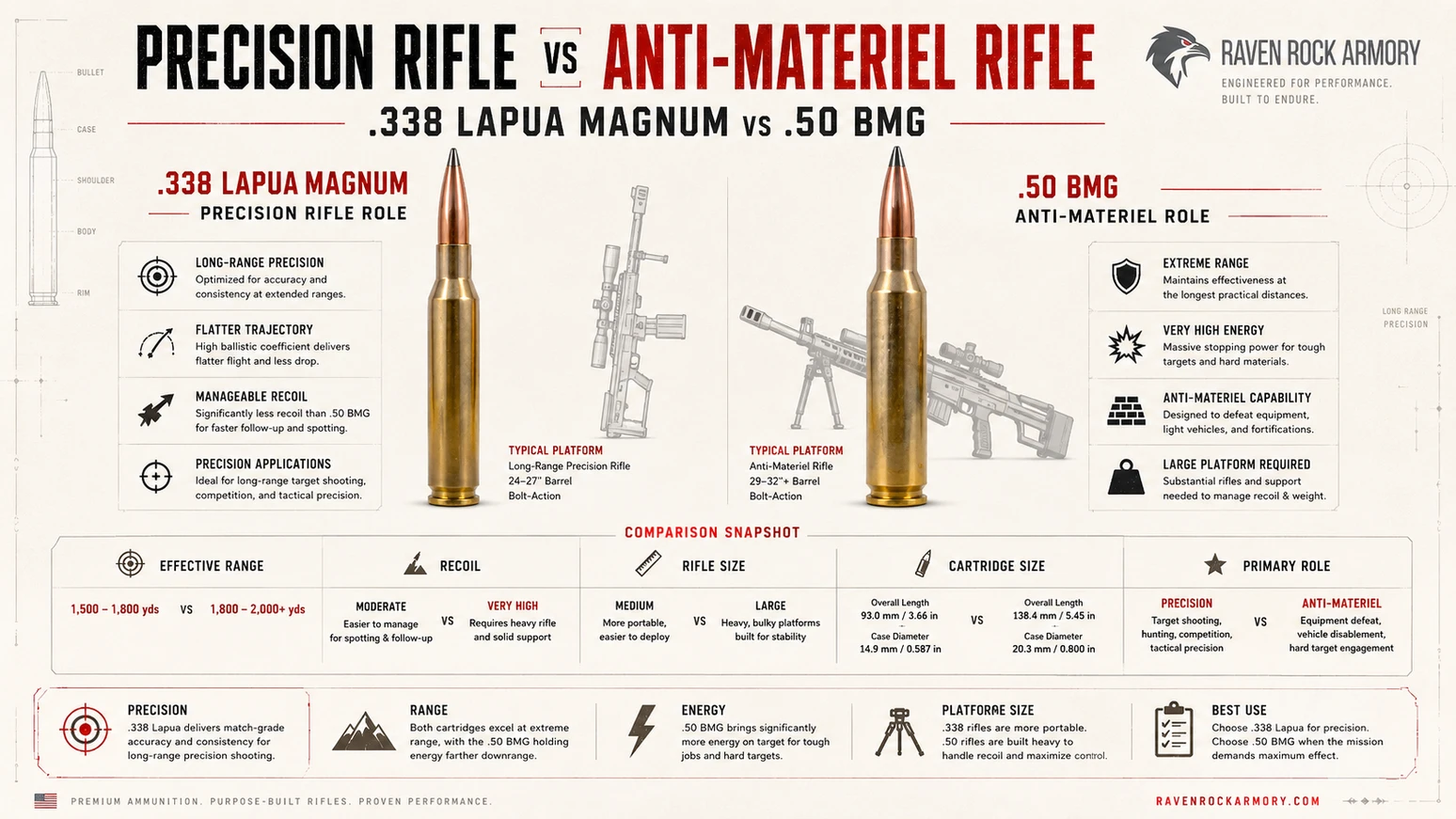
The image compares an ORSIS T-5000-style precision rifle chambered in .338 Lapua Magnum with a Barrett M82-style anti-materiel rifle chambered in .50 BMG. While some of the labels and specifications in the image appear simplified or inaccurate, the overall comparison is useful: .338 Lapua Magnum and .50 BMG represent two very different approaches to long-range rifle performance.
At Raven Rock Armory, customers can browse rifles, tactical rifles, rifle ammunition, rifle scopes, gun rests, bipods, and tripods, and related tactical gear for long-range, hunting, range, and precision rifle applications.
What Is a Precision Rifle?
A precision rifle is built to deliver consistent accuracy. These rifles often use bolt-action systems, heavy or match-grade barrels, adjustable stocks, quality triggers, stable chassis systems, high-magnification optics, and precision ammunition. The goal is repeatable performance at distance.
A .338 Lapua Magnum precision rifle is a serious long-range platform. It offers more power and extended-range capability than many common rifle cartridges, but it also requires a heavier rifle, strong optics, stable support gear, and a shooter who understands recoil management and long-range ballistics.
What Is an Anti-Materiel Rifle?
An anti-materiel rifle is designed around power and energy against equipment, vehicles, barriers, or other hardened battlefield targets. The Barrett M82-style rifle chambered in .50 BMG is one of the most recognized examples of this category.
For civilian shooters, .50 BMG rifles are typically specialty firearms used for long-range target shooting, collecting, and large-caliber interest. They are not general-purpose rifles. The size, weight, ammunition cost, muzzle blast, recoil, and range requirements make them highly specialized platforms.
.338 Lapua Magnum: Long-Range Precision Cartridge
The .338 Lapua Magnum is known for long-range precision, high ballistic performance, and strong retained energy at distance. It sits above cartridges like .308 Winchester and 6.5 Creedmoor in power, recoil, and cost, but below .50 BMG in size and raw energy.
For experienced long-range shooters, .338 Lapua Magnum can make sense when extended-range capability is the goal. It requires quality ammunition, a capable rifle, a strong scope, proper support gear, and a range environment where the cartridge can actually be used effectively.
.50 BMG: Extreme Power and Specialty Use
The .50 BMG cartridge is much larger and more powerful than .338 Lapua Magnum. It is famous for extreme energy, long-range capability, heavy projectile weight, and use in large anti-materiel rifle platforms such as the Barrett M82.
The tradeoff is practicality. .50 BMG rifles are heavy, expensive to shoot, loud, high-recoil, and require appropriate range access. For most shooters, .50 BMG is a specialty platform rather than a practical everyday rifle choice.
Bolt-Action vs. Semi-Automatic Operation
The ORSIS T-5000-style rifle shown in the image represents a bolt-action precision rifle. Bolt-action rifles are often favored for precision because they are mechanically simple, rigid, and consistent. They also encourage deliberate shooting and careful follow-through.
The Barrett M82-style rifle represents a semi-automatic .50 BMG platform. Semi-automatic operation allows faster follow-up shots, but the rifle is larger, heavier, and more complex. In this category, semi-auto capability is valuable, but the rifle is still highly specialized.
Optics and Rifle Scope Selection
Both rifle types require serious optics. A .338 Lapua Magnum precision rifle typically benefits from a high-quality long-range scope with clear glass, repeatable turret adjustments, a useful reticle, and proper magnification range. A .50 BMG rifle also requires a durable optic capable of handling recoil and maintaining zero.
Raven Rock Armory offers related categories for rifle scopes, optics, scope mounts, rings, and long-range shooting accessories. For precision rifle work, the optic is not an afterthought. It is a critical part of the system.
Recoil, Weight, and Shooter Control
Recoil management is a major difference between these rifle categories. A .338 Lapua Magnum rifle produces significant recoil, but it is generally more manageable than .50 BMG when the rifle is properly configured with weight, stock fit, a muzzle brake, and good shooting technique.
A .50 BMG rifle produces far more blast and recoil energy. Large muzzle brakes and heavy rifle weight help control it, but the shooting experience is still very different from smaller precision rifle cartridges. Shooters should consider physical comfort, range rules, hearing protection, and training cost before choosing a large-caliber rifle.
When .338 Lapua Magnum Makes Sense
A .338 Lapua Magnum rifle may make sense for experienced shooters who want serious long-range capability without moving all the way into .50 BMG territory. It can be a strong choice for precision shooting, long-range target work, and customers who want a powerful magnum rifle cartridge with excellent ballistic potential.
Before choosing .338 Lapua Magnum, consider ammunition cost, rifle weight, recoil, optic budget, barrel life, range access, and whether a more common caliber like .308 Winchester, 6.5 Creedmoor, or .300 Win Mag may be more practical.
When .50 BMG Makes Sense
A .50 BMG rifle is best viewed as a specialty firearm. It may appeal to collectors, large-caliber enthusiasts, and shooters with access to ranges that can safely support .50 BMG use. It delivers extreme power, but that power comes with major tradeoffs in cost, size, weight, blast, and practicality.
For most customers, .50 BMG is not the first long-range rifle to buy. It is usually something to consider after gaining experience with more practical long-range platforms.
Related Categories at Raven Rock Armory
- Firearms
- Rifles
- Tactical Rifles
- Ammunition
- Rifle Ammo
- Optics
- Rifle Scopes
- Gun Rests, Bipods & Tripods
- Muzzle Devices
- Special Orders
Final Thoughts
The ORSIS T-5000-style .338 Lapua Magnum rifle and Barrett M82-style .50 BMG rifle represent two different long-range priorities. The .338 Lapua Magnum precision rifle is built around accuracy, consistency, and shooter control. The .50 BMG anti-materiel rifle is built around extreme energy, size, and specialized performance.
For most shooters, a practical long-range rifle setup starts with the right rifle, caliber, optic, ammunition, bipod, muzzle device, and training plan. Whether you are comparing precision rifles, rifle ammunition, long-range optics, bipods, muzzle devices, or special order firearm options, Raven Rock Armory offers organized categories and local support for responsible firearm owners.
Important: Firearms, ammunition, magazines, suppressors, and regulated accessories must comply with all applicable federal, state, and local laws. Firearms must transfer through a valid FFL where required. Product availability, legality, and transfer requirements may vary.
Explore Popular Articles